Burnout, Boundaries and Healing: A New Year, A New Way of Being

Updated: Sep 12

When the End of the Year Feels Heavy Rather Than Reflective
The final days of the year are often framed as a time for reflection, gratitude, and closure. There is an assumption that, once the busyness of December subsides, something should soften. That rest should arrive. That clarity should follow the pause.
But for many people, the end of the year does not feel spacious or reflective. It feels heavy. Depleting. Or strangely hollow. You may notice that the tiredness hasn’t lifted after time off. You may feel emotionally flat, irritable, or quietly overwhelmed. You may find yourself limping toward the finish line rather than arriving with relief.
If that’s where you are as this year draws to a close, it’s important to name this gently: you are not doing the end of the year “wrong”. You are not failing to be grateful, reflective, or resilient. What you may be feeling is not a lack of perspective or motivation, but the accumulated weight of burnout.
As one year ends and another approaches, there is often pressure — subtle or explicit — to reset. To resolve. To emerge renewed. But burnout does not heal through reflection lists, fresh goals, or a renewed push for self-improvement. It asks for something very different: understanding, boundaries, and repair.
What Burnout Really Is (And Why It’s Often Missed)
Burnout is often described as “too much stress”, but this simplification misses its depth. Burnout is a state of emotional, physical, and mental depletion that develops when prolonged stress outweighs recovery for too long. Unlike ordinary tiredness, it does not simply resolve with rest. A break may bring temporary relief, but the underlying exhaustion, detachment, or sense of being overwhelmed tends to persist.
What makes burnout particularly painful is that it reaches far beyond energy levels. It affects how you think, how you feel, how you relate, and how connected you feel to yourself. Work can begin to feel meaningless. Relationships may feel effortful or draining. Even pleasure, which is often assumed to be restorative, can feel distant or muted.
Burnout rarely arrives dramatically. It tends to develop quietly, over months or years. Many people don’t recognise it at first because it disguises itself as coping. You keep going. You stay functional. You meet expectations. From the outside, you may appear capable, reliable, or high-functioning — especially as the year demands its final efforts.
Inside, however, something gradually thins.
Burnout as a Survival Pattern, Not a Personal Failure
For many people, burnout is not only about workload or external pressure. It is also shaped by long-standing patterns of survival.
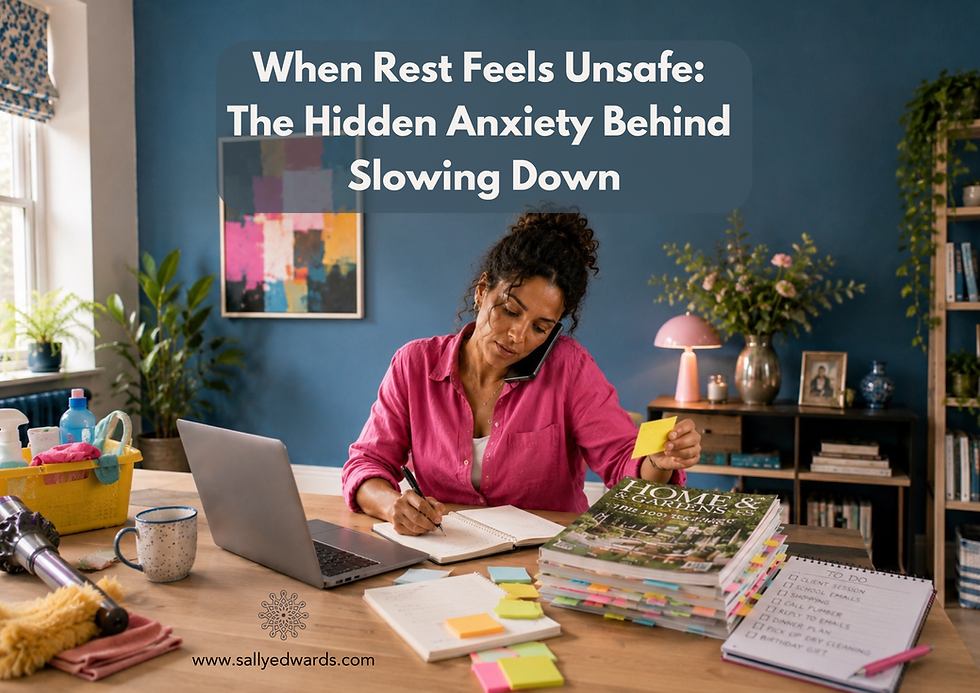
If you learned early in life — directly or indirectly — that safety, belonging, or approval came from being useful, responsible, emotionally contained, or competent, then over-functioning may feel deeply familiar. Slowing down can feel uncomfortable or even unsafe. Rest may trigger guilt, anxiety, or an internal voice that insists you should be doing more, especially when there is still so much “to finish” before the year ends.
Over time, the nervous system adapts to this way of living. It becomes organised around doing, managing, holding things together. Burnout, in this sense, is not sudden collapse. It is survival that has been asked to operate without pause for too long.
This is why burnout is not simply about doing too much. It is about being too alone with too much, for too long.
The Quiet Signs Burnout Has Been Building All Year
Burnout rarely announces itself clearly. More often, it accumulates quietly, through subtle internal shifts that are easy to rationalise or dismiss — especially in a culture that rewards endurance.
Life may begin to feel flat rather than actively distressing. Joy, curiosity, or anticipation quietly fade. You may notice yourself withdrawing in small ways — cancelling plans, delaying decisions, avoiding tasks — not because you are resting, but because everything feels like too much effort.
There is often a persistent sense of “just one more thing”. Rest is deferred until after the next deadline, the next commitment, the next seasonal demand. At the end of the year, this can intensify, with the belief that you just need to get through December and then you’ll finally stop. But the stopping never quite arrives.
Alongside this, the body’s signals are frequently overridden. Hunger, thirst, fatigue, tension, shallow breathing — these early messages are ignored in service of getting through the day. Emotionally, you may oscillate between numbness and overwhelm, describing yourself as “fine” while feeling increasingly disconnected from what that word actually means.
Underneath it all often runs a familiar narrative: that you should be coping better. That everyone else seems to manage. That if you were stronger, more organised, or less sensitive, you wouldn’t feel like this. Shame settles in quietly — and shame, in turn, keeps burnout firmly in place.
When Burnout Deepens Toward the End of the Year
When these early signs are missed or pushed through, burnout can deepen into a more profound state of depletion. By the end of the year, many people reach a point where daily functioning itself feels difficult.
Exhaustion becomes heavier and more pervasive. Getting out of bed can feel like an effort. Concentration and memory falter. Decision-making becomes draining. Emotional range narrows, or emotions spill out unexpectedly. You may feel disconnected from meaning, purpose, or even from yourself.
The body often begins to speak more loudly at this stage, through persistent pain, frequent illness, digestive problems, headaches, or disrupted sleep. Coping strategies that once felt manageable — zoning out, comfort eating, drinking, scrolling — may increase as the system looks for relief.
It’s vital to say this clearly: these are not signs of weakness or failure. They are the mind and body’s way of signalling that something needs care and change.
This is not the moment to push harder into the final days of the year. It is the moment to pause, to listen, and to consider what you have been carrying.
Burnout, the Nervous System, and Why Rest Can Feel So Hard
Burnout is not only psychological; it is deeply physiological. Prolonged stress dysregulates the nervous system, often leaving people moving between states of high activation and shutdown.
You may notice yourself oscillating between anxiety, agitation, and overdrive on one hand, and numbness, collapse, or emotional disconnection on the other. Sometimes what looks like calm at the end of the year is actually shutdown. You’re not at peace — you’re switched off. This is not a personal failing. It is a protective response to prolonged strain.
Understanding burnout through the nervous system can be profoundly relieving. It shifts the question from “What’s wrong with me?” to “What has my system been coping with for a long time?”
Healing begins not with forced positivity or productivity, but with gently supporting the nervous system back into safety and connection.
Why Boundaries Matter More Than Resolutions
As the year closes, there is often an unspoken pressure to resolve to do better next year. To be more balanced. More organised. More disciplined. But without boundaries, burnout simply repeats itself.
Boundaries are often misunderstood as rules, walls, or acts of selfishness. In reality, boundaries are about care. They are how we honour our limits — emotional, physical, relational — and protect our nervous system’s capacity.

When we repeatedly override our limits to meet expectations, whether those expectations come from others or from within, we slowly disconnect from what we need. Resentment builds. Exhaustion deepens. Disconnection follows.
For people with trauma histories, boundaries can be especially complex. Trauma often involves violations of autonomy, safety, or control. You may have learned that saying no leads to rejection, conflict, or punishment. Over-accommodation, people-pleasing, or self-silencing may once have been necessary for survival.
In this context, boundary-setting is not a simple skill to master before the new year begins. It is a relational and nervous-system task. It can bring guilt, fear, or shame — even when it is essential for wellbeing.
Boundaries are not about control. They are about repair. When you begin to say “this is my limit” with clarity and kindness, your nervous system often begins to feel safer.
The Inner Conflict Between Holding On and Letting Go
Many people experiencing burnout notice a strong inner tension as the year ends. One part pushes to keep going, to finish strong, to not let anyone down. Another part feels exhausted, resentful, or desperate for rest.
Both parts are trying to protect you.
Burnout recovery does not come from silencing one part in favour of another. It comes from listening with compassion and curiosity. From wondering what each part fears, and what each part needs. Often, the part that pushes hardest is afraid of collapse, rejection, or being seen as inadequate. The part that longs to stop is asking for care, rest, and recognition.
When we begin to bring kindness to this inner conflict, something softens. Space opens for choice rather than compulsion.
Burnout Is Not Just Personal
It is also important to name that burnout is not only individual. It is shaped by culture and systems.
Overwork, productivity culture, inequality, and unrecognised emotional labour all contribute. People in caring roles, marginalised communities, or environments that demand constant vigilance and adaptation are at higher risk. Burnout, in these contexts, is not pathology — it is often a reasonable response to unreasonable demands.
Recognising this reduces shame and reframes healing as something that involves both internal and external change.
Moving Toward 2026 With Care Rather Than Pressure
So what might it mean to move toward a new year when burnout is part of the picture?
Perhaps it does not mean reinvention. Perhaps it does not mean becoming a better, stronger, more efficient version of yourself. Perhaps it means a gentler re-orientation. A new relationship with your limits, your body, and your capacity.
Burnout recovery is rarely quick or linear. It is often a slow remembering of what supports you: rest, nourishment, connection, support, self-respect. It involves learning to move at a pace that matches your capacity — not because you are weak, but because you are wise.
As this year comes to a close, you are not required to set resolutions. You are allowed to rest. You are allowed to arrive at the threshold of a new year exactly as you are.
Burnout does not mean you are broken. It means you have been carrying too much, for too long, often without enough support.
Healing is possible.
And you do not have to do it alone.