When Rest Feels Unsafe: The Hidden Anxiety Behind Slowing Down

Updated: Sep 12
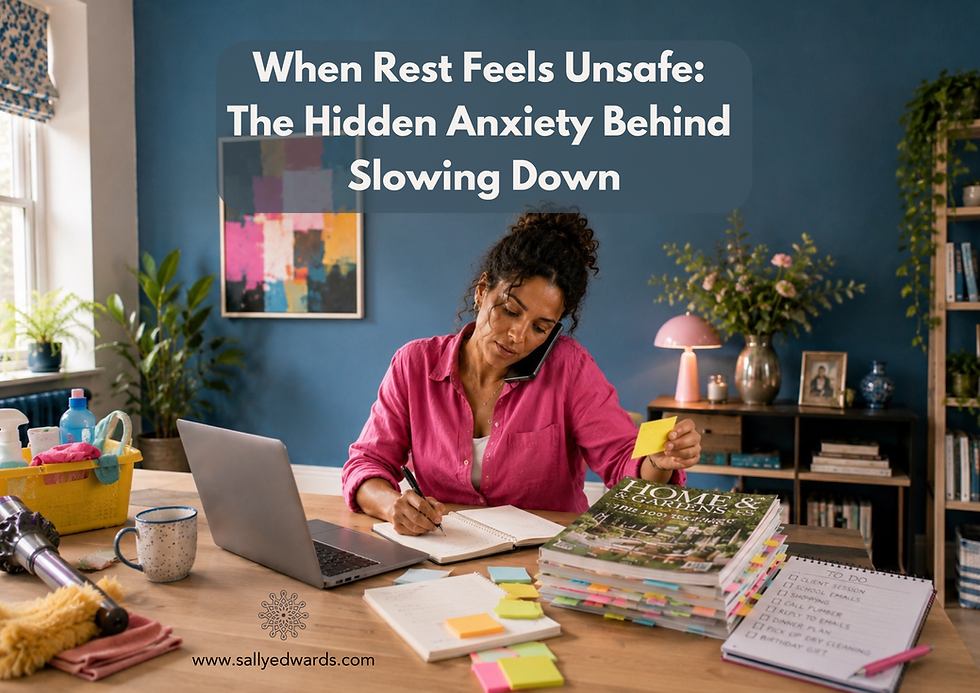
You book a week away and, before you've even arrived, you've researched the restaurants, mapped the walks and made a list of things you might do. You sit down to watch a film and find yourself folding laundry, answering messages, checking tomorrow's diary. Sunday afternoon stretches ahead with nowhere you need to be — and instead of relief, something inside you starts to itch. Somewhere along the way, you learned to keep moving — and now you do it without even noticing.
This isn't quite the same thing as burnout. Burnout is what can happen when sustained demands deplete us. This is about something different: what happens inside you the moment the demands disappear and there is finally nothing you have to do.
Perhaps you've promised yourself a completely lazy day, only to find that by mid-morning you've put a wash on, cleared a cupboard, replied to a load of emails and started thinking about dinner. The day is technically your own, but doing nothing with it feels strangely wasteful.
Perhaps you've noticed that the first day of a holiday can feel surprisingly uncomfortable. You've been longing for the break for weeks, yet when it finally arrives there is a low hum of agitation underneath it. You can't quite settle. You start wondering what everyone wants to do tomorrow.
Perhaps stillness itself seems to create an urge — to reach for the phone, make tea, check something, plan something. Anything that gives the next few minutes a shape.
Perhaps you've always thought of this as simply who you are. Productive. Organised Someone who likes to be busy. A doer. And perhaps you've never quite considered that underneath all that competence there might also be a reluctance to stop.
And then underneath that, the question: What would happen if I actually stopped?
What this actually is
There is an important difference between being busy because life is busy, and staying busy because stillness feels difficult to tolerate. There is also a difference between burnout and a fear of stopping, although the two can coexist. Burnout is depletion: too much has been asked of a system for too long. A fear of rest is different. Here, the absence of demand can itself become uncomfortable — you may desperately want a break and then discover that you don't quite know how to inhabit one.
This isn't laziness, and it isn't simply ambition either. It can be an active protective strategy — a nervous system that has learned, somewhere along the way, that movement is safer than stillness. When you are doing, there is structure. There is a next thing. Your attention has somewhere to go — problems to solve, people to respond to, lists to complete. Stopping removes all of that, and what's left can feel unexpectedly exposed.
This is why rest can become something you unconsciously defend against even while consciously craving it. The problem isn't that circumstances won't allow you to rest. Sometimes, for the first time in ages, they finally do — and that's when you discover that something inside you won't.
Why it happens
Children learn safety through experience, not explanation. They notice what happens in their homes when things become quiet, what gets rewarded, when adults are available and when they aren't. They learn which versions of themselves make life run more smoothly.
For some children, unstructured time wasn't particularly peaceful. Perhaps quiet meant waiting for the next argument, or a mood that could change without warning — and staying occupied offered a small island of predictability inside it. For others, being still meant becoming available: if you weren't occupied, someone could ask something of you, draw you into an adult's emotions, expect you to help, soothe, mediate. Keeping busy created a little distance.
And sometimes the learning is less obviously traumatic. Perhaps achievement was where warmth lived. You were praised for doing well, working hard, being mature — and the adults around you may have loved you deeply, but somehow the most visible version of you became the capable one. Capability grew, and underneath it, almost invisibly, a rule formed: when I am doing something useful, I am okay. The opposite is rarely stated aloud, but children are remarkably good at filling in blanks.
Imagine a child who learns early to keep herself occupied — homework done without being asked, a room tidied, an eye kept on what needs doing before anyone has to say so. The adults call her mature, sensible, no trouble at all, and she quietly builds an identity around their approval. When the atmosphere in the house grows tense, she finds another task. Nobody tells her she isn't allowed to rest; doing has simply become the place where she feels safest. She grows up. The homework becomes work, the tidying becomes lists, the vigilance becomes productivity — and because the adult version of this looks admirable, the child underneath it stays almost completely hidden.
This is one reason these patterns can be so difficult to recognise: constant doing is frequently rewarded. You get things done, people rely on you, you cope — the adaptation looks like a strength, and in many ways it is one. The difficulty is not that you learned to be capable. It's that capability may have become compulsory.
How it shows up
A difficulty with rest doesn't usually look dramatic. More often, it hides inside ordinary life — in the multitasking of relaxation itself: television with one eye on emails, a podcast because simply walking feels insufficient, a bath with the phone close by. Even rest needs to accomplish something.
It might show up as needing structure inside downtime. A weekend with plans feels enjoyable; a weekend with nothing in the diary feels oddly disorientating. Holidays become itineraries. Free afternoons acquire jobs. It might show up as guilt — you sit down in the middle of the day and, within minutes, a voice appears: I should really... There is always something that could be done, of course. Houses can always be cleaner, work can always be further ahead. Life provides an endless supply of evidence for a nervous system already convinced that stopping is irresponsible.
Sometimes it appears at night, when the body is tired but the mind needs one more episode, one more scroll — because silence feels too abrupt, and sleep requires a kind of runway. And sometimes it looks like irritation: a queue, a delay, a cancelled plan that leaves an unexpected hole in the day. The agitation can seem disproportionate until you realise the problem isn't really the queue — you've been forced into stillness without choosing it.
Even holidays can become exhausting, when you return needing a break from the break because you spent the entire time making sure every day contained enough.
Filling the day differently isn't the same as stopping. Rest means actually stopping.
The hidden cost
Constant movement works remarkably well as a way of avoiding whatever stopping might bring into awareness — which is precisely the problem. If you never stop for long enough to discover what happens, the nervous system never gets the chance to learn that stopping can be safe. The old prediction remains intact, and more doing cannot resolve a fear of not doing.
This can create a particularly frustrating kind of exhaustion. You recognise that you're tired, reduce your workload, take a holiday — and still don't feel restored, because having time available for rest and actually entering a state of rest are not the same thing.
There can also be a quieter loss: the erosion of a felt sense of who you are when you're not producing something. Ask someone caught in this pattern what they do, and the answer comes easily. Ask what they enjoy when nothing useful is being achieved, and there may be a pause. Pleasure itself can become strangely instrumental — exercise has a target, reading should teach you something, even self-care becomes another project to optimise.
The cost reaches relationships too. Sometimes what the people we love need from us isn't another task completed — it's our presence, and presence is difficult when some part of us is perpetually leaning towards the next thing. You can spend enormous energy caring for people while finding it much harder simply to be with them.
Eventually, for some people, the body begins to object — headaches, exhaustion, the injury that means exercise has to stop. It can feel as though the body has betrayed you. Sometimes it’s worth wondering whether it has simply done what the conscious mind could not permit: brought everything to a halt. Not because illness is "caused" by an inability to rest — bodies become ill for countless reasons — but because when rest is only legitimate once it's medically unavoidable, illness becomes one of the rare occasions stopping comes without guilt. And that is a difficult way to live.
Why "just relax" doesn't work
The advice sounds so reasonable: take a day off, put your feet up, have a lie-in, just relax. But if rest feels unsafe, relaxation was never a permissions problem. You may already know you're allowed to rest. The difficulty is that another part of you doesn't experience stopping as neutral.
Think of that part as a kind of internal protector — the one that keeps you moving, planning, staying a step ahead. It does this because, somewhere back in its history, those behaviours worked. They kept chaos at bay. They kept uncomfortable feelings out of awareness. They gave you a sense of control when control was hard to come by. So when you try to force that part into silence, you usually get the opposite of relaxation: you clear an afternoon, tell yourself you're going to do absolutely nothing, and the anxiety rises until you find something to do — and almost immediately feel better. The lesson your system takes from this is simple: stopping felt awful, moving fixed it — and the pattern gets a little stronger.
Part of this is physical. Your body has grown used to running in a particular gear — geared towards action, alertness, always slightly braced for the next thing. That gear has become familiar, even comfortable in its own way. Calm, by contrast, can feel strange, even though it's what you want. Unfamiliar doesn't automatically feel safe, however much you might wish it did.
This is why simply understanding the pattern rarely undoes it. You can know exactly why you do what you do and still find yourself cleaning the kitchen twenty minutes into the afternoon you'd promised yourself you'd spend reading. You're not being difficult. You're doing what you learned to do.
What actually helps
The answer is not to become better at forcing yourself to rest. It is to become curious about what part of you doesn't want you to.
Instead of treating the urge to keep moving as another bad habit to conquer, you begin to notice it. You sit down. The urge arrives — I'll just put that washing away — and rather than immediately obeying it, or fighting it, you notice: there you are. What does this part believe would happen if you didn't get up? Perhaps the answer is anxiety, or guilt, or a sense of wasting time, or the uncomfortable feeling that everyone else is getting on with life while you are doing nothing. Perhaps something sadder arrives underneath the busyness once the noise dies down. Or perhaps there is no clear answer at all — only a physical sensation that says move. That is enough to begin with.
The work is not to rip away a strategy that has been useful for decades. It is to help the system discover, gradually, that it has other options now. If ten minutes of stillness makes your whole system revolt, prescribing an entire "rest day" is likely to be too much. Instead, rest can be approached in small, chosen doses: five minutes outside without your phone, a cup of tea drunk without doing anything else alongside it, a small gap left before the next task begins. This isn't about proving anything. It is titrated experience: enough contact with stillness for the nervous system to encounter something new, but not so much that the protector part has to slam the door shut.

Because the pattern lives in the body as well as the mind, this work is somatic too — not relaxation imposed from above, but slowly learning the sensations of settling: the support of the chair beneath you, the exhale lengthening naturally, the room orienting itself as safe in real time. Work in therapy can also help uncover what emerges once the activity quietens — the feelings busyness may have kept at a distance, and the beliefs about worth and safety hiding inside productivity.
The aim isn't to become a person who spends hours doing nothing, or even to become less productive. It’s to restore choice — to move when you want to, and stop when you need to. To discover that usefulness is something you can offer, not something you have to continuously prove.
Perhaps, eventually, you book the holiday without needing to account for every hour. Perhaps the film plays and the laundry stays in the basket. Perhaps Sunday afternoon arrives with nothing in it and, instead of immediately reaching for something to fill the space, you notice the old question — what would happen if I actually stopped? — and this time, you stay long enough to begin finding out.
You were never lazy. And rest was never really the problem. The problem was that somewhere along the way, your system learned that doing meant safety, and stopping meant something else. That learning made sense once. But it doesn’t have to organise your life forever.
Rest isn't something you earn once everything is finally finished. Everything will never be finished. Rest is discovering that, for this moment, there's nothing you need to do.
And nothing you need to prove, either.